
© Joe Douglas. 2016
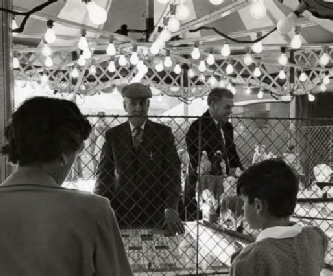
The playing table was a grid of squares with thick black edges and containing numbers, 2 to 5 if I remember correctly. Pennies, (the big old 1d), were rolled down a moveable ramp and if it stopped and lay flat in a square without touching any black edge the player was rewarded with the number of pennies marked in the square.
The operator in the centre of the stall serviced all the tables, retrieving and dispensing pennies as required from the stack in his hand. A flick of the wrist sent the pennies back to the punter usually at a steady speed across the table surface.
The occasional punter, thinking the operator wasn’t looking, would reach over the table and nudge his penny off the black. It was amazing how much pain you could inflict on a daring finger with a well aimed, high speed spinning penny. This cheating was a minor problem in all the places I worked except Workington where the stall was fitted with wire screens to keep straying hands off the table.
I spent time in a ‘Wheel-
This Photograph is from the
Main Library,
University of Sheffield,
Sheffield, S10 2TN, UK,
Tel: 0114 222 7231
Which is a very good source of information on Fairground rides and Fairground history.
Wheel-